
Nonviolent Communication Book Review: A Therapist’s Take on Communication, Needs, and Boundaries
As a registered clinical counsellor, I’m often sitting with people in the aftermath of conversations that didn’t go the way they hoped. Not because they didn’t care—but because they didn’t have the language for what was happening inside them, or because their words didn’t land the way they needed them to.
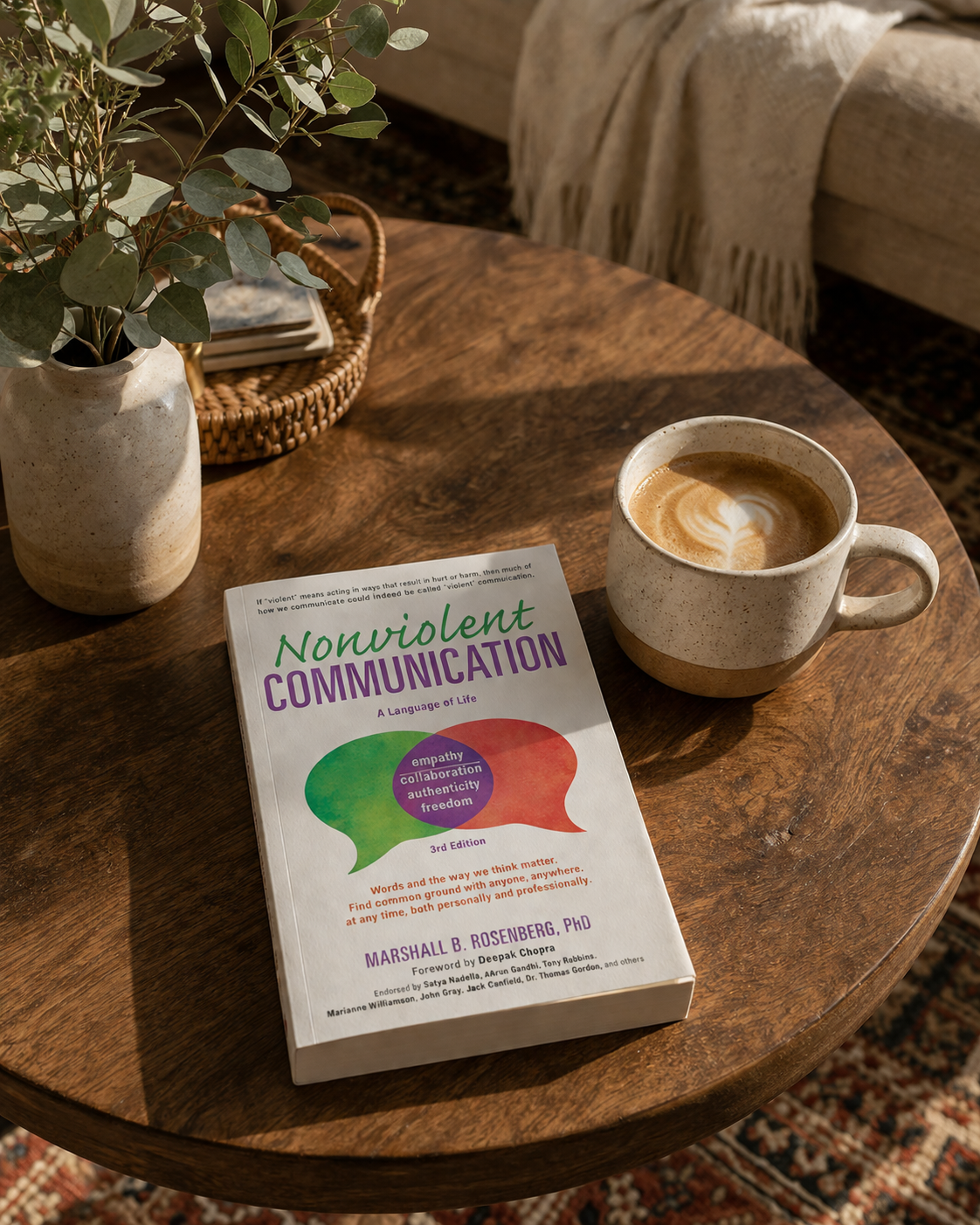
Nonviolent Communication is one of those books that comes up again and again in conversations about communication in relationships, emotional awareness, and repair. I picked it up wanting to explore whether it could offer something practical—not just in theory, but in the lived, complex dynamics I see in therapy every day.
What Nonviolent Communication Is Really About
At its core, Nonviolent Communication: A Language of Life offers a framework for communicating with more clarity, empathy, and intention.
Dr. Marshall Rosenberg breaks this down into four parts:
Observations (what actually happened, without judgment)
Feelings (what’s happening emotionally)
Needs (what matters or is missing underneath)
Requests (what we’re asking for moving forward)
It’s a practical, example-driven book. Less about theory, more about how communication can shift when we slow down enough to understand both ourselves and others more clearly.
And while the structure is simple, actually applying it—especially in emotionally charged moments—is where the real work begins.
A Few Things That Really Stuck With Me
There were a few ideas that stayed with me as I read, both personally and in how I think about my work with clients.
We often think we’re being clear… when we’re actually communicating in layers of interpretation.
Something as simple as separating an observation from a judgment can completely change how a message is received.
Feelings and thoughts are not the same thing.
“I feel like you don’t care” is something I hear often—but it’s not actually a feeling. It’s an interpretation. And when we stay there, we can lose access to what’s more vulnerable underneath, like hurt, disappointment, or loneliness.
This is part of why I often bring in tools like a feelings wheel in my work. Because for many people—especially those navigating relational trauma—being asked “What are you feeling?” can feel surprisingly hard to answer.
Sometimes the doorway isn’t cognitive—it’s physical.
A tight chest.
A heaviness in the stomach.
A sense of agitation or shutdown.
From there, we can begin to gently name what might be present. And once there’s language, communication in relationships starts to shift in a more grounded way.
All behaviour is an attempt to meet a need.
This idea can be grounding. It helps create space for empathy, even when we don’t agree with someone’s actions.
And at the same time, it’s something I hold with nuance—because understanding someone’s behaviour doesn’t mean we need to tolerate it.
What This Can Look Like in Real Life
One of the strengths of this book is that it gives people a starting point—a way to slow conversations down enough to become more intentional.
Some ways this can look in everyday life:
Pause before responding
Ask yourself: What am I actually feeling right now? What do I need?Use simple, grounded language
Instead of reacting from overwhelm, try:
“When this happened, I felt ___ because I needed ___.”Build emotional awareness first
This is where tools like a feelings wheel can be incredibly supportive. When you can identify both the emotional and physical experience of what’s happening inside you, it becomes much easier to communicate it clearly.
This kind of work often supports:
reducing reactivity
strengthening emotional awareness
helping people move from confusion → clarity
And it pairs naturally with the kind of deeper work many people explore in counselling—especially around communication patterns, boundaries, and self-trust.
Where This Lands for Me as a Therapist
There’s a lot about this framework that I genuinely appreciate. It aligns closely with trauma-informed work—particularly around slowing down, increasing awareness, and taking responsibility for our internal experience.
But something I kept coming back to as I read is this:
These tools are not equally effective in all relationships.
Many of the clients I work with have already tried—multiple times—to communicate clearly, kindly, and thoughtfully. They’ve reflected on their feelings. They’ve softened their language. They’ve tried to “say it the right way.”
And still, they’re met with defensiveness, dismissal, or harm.
In those dynamics—especially in relationships where there are narcissistic traits or chronic invalidation—communication tools can start to feel frustrating or even discouraging.
Not because they’re wrong.
But because they rely on something that may not be present: mutuality.
Without that, it can quietly reinforce a belief I hear often:
“If I could just explain myself better, maybe things would change.”
And part of the work becomes gently unpacking that—and shifting toward something that often feels harder, but more protective:
Sometimes that shift sounds like:
“If this conversation becomes critical, I’m going to step away.”
A different kind of clarity—one that doesn’t depend on the other person’s response.
Who This Book Might Be Helpful For
I would recommend this book for:
People wanting to improve communication in relationships
Individuals building emotional awareness and self-understanding
Therapists, coaches, or helping professionals looking for a structured communication framework
A gentle note on limitations:
If you are navigating a relationship where there is ongoing invalidation, manipulation, or lack of respect, communication tools alone may not create change. In these situations, learning to set boundaries and prioritize emotional safety is just as important—if not more so.
Final Thoughts (And What I’d Take From It)
Nonviolent Communication offers something many people are looking for: a way to make sense of what they’re feeling and how to express it more clearly.
And that matters.
At the same time, I think its value deepens when we hold it with nuance.
For me, this book isn’t just about learning how to communicate differently with others. It’s about helping people become more connected to themselves—so that whatever they choose next, whether that’s expressing a need or setting a boundary, comes from a place of clarity rather than confusion.
Because sometimes the most important shift isn’t finding better words.
It’s realizing you were already making sense—and allowing that to guide what you do next.