
Peak Mind Book Review: How 12 Minutes of Mindfulness a Day Can Improve Focus and Reduce Stress
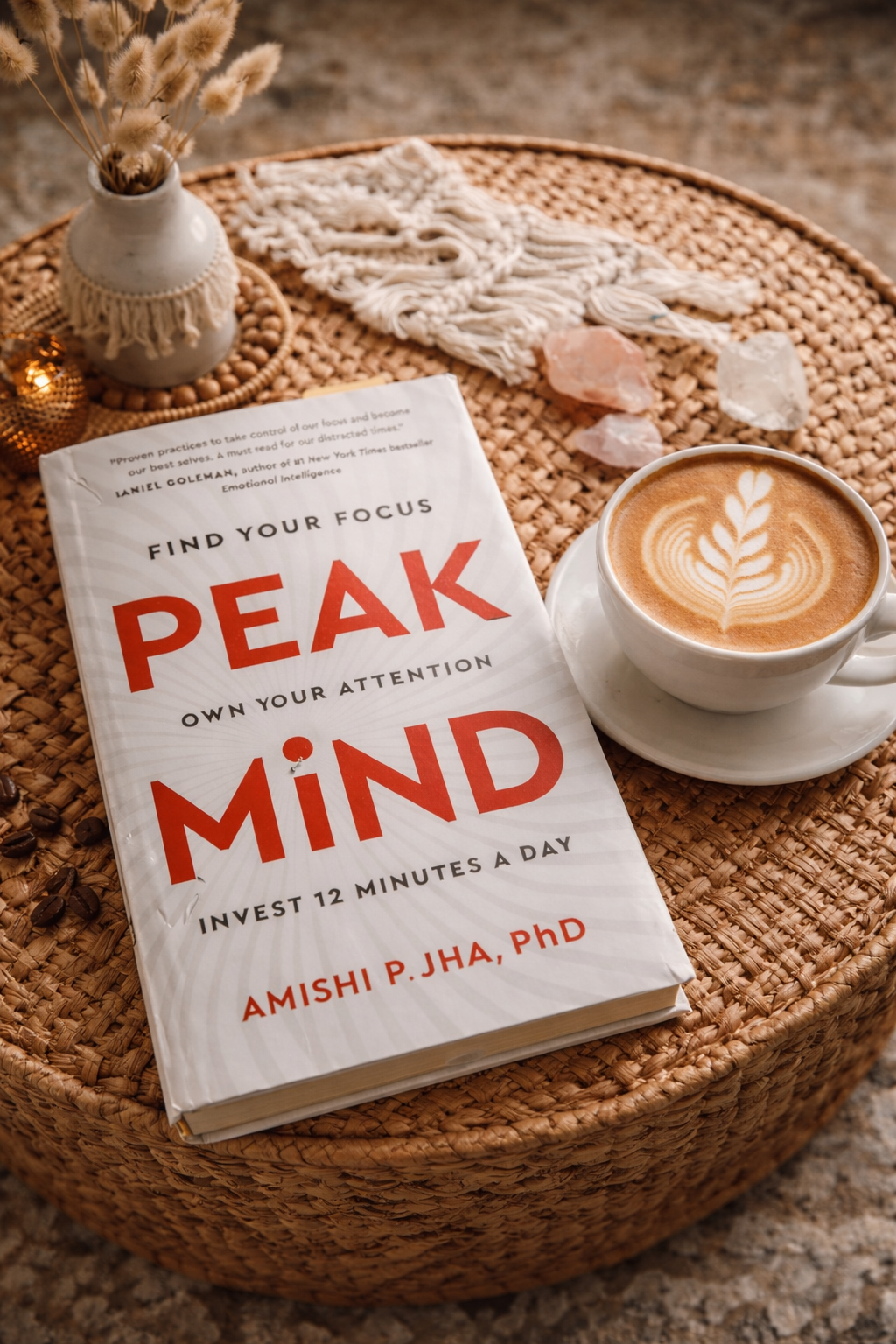
I came across Peak Mind by Dr. Amishi Jha this fall while listening to a Mel Robbins podcast where she interviewed the author. What initially hooked me wasn’t the neuroscience (though I love a good research-backed book), but the idea that we can actually train our attention with as little as 12 minutes of practice a day.
In therapy sessions, I often talk with clients about mindfulness as a way to reduce stress and anxiety, feel more grounded, and create a little space between thoughts and reactions. What I appreciated about this book is that it doesn’t frame mindfulness as something abstract or spiritualized—it’s presented as mental training, much like exercising a muscle.
One moment from the interview (and later the book) really stayed with me. Dr. Jha shared something she often says to soldiers she works with:
“Don’t depart before you depart.”
In other words, try not to mentally leave the present moment by worrying about what might happen in the future. For anyone who struggles with anxiety, hypervigilance, or chronic stress, this likely hits close to home.
So what is Peak Mind actually about?
At its core, Peak Mind is about attention—how it works, why we lose it so easily, and how modern life constantly pulls it away from us. Dr. Jha explains that attention shapes our experience of life: what we notice, what we remember, how we make decisions, and even how we connect with others. When our attention is scattered, we’re often only half-living our lives.
One thing I really appreciated is how normalizing this book feels. Jha draws from years of research with groups like soldiers, first responders, students, and athletes—people under real pressure—to show that attention isn’t broken or defective. It’s simply overloaded. And importantly, it’s trainable.
She breaks attention down into three systems using metaphors that make the science much easier to understand:
The flashlight (our focused attention),
The floodlight (our broader awareness of what’s happening around us),
And the juggler (the part of us that manages goals, priorities, and decision-making).
When stress, anxiety, or negative mood shows up, those systems don’t work as efficiently. Our brains start “time traveling”—into worry about the future or replaying the past—which pulls attention away from the present moment.
A few ideas that really stood out to me
One of the most important reminders in this book is that mind-wandering isn’t a failure. Our brains are wired to wander. The practice isn’t about stopping thoughts—it’s about noticing when attention drifts and gently bringing it back. That noticing is the training.
Another key takeaway is how closely attention and working memory are linked. When attention is scattered, learning, problem-solving, and emotional regulation all become harder. Mindfulness helps stabilize attention, which in turn supports memory and clearer thinking.
And then there’s the part I think many people will find most relieving:
You don’t need to meditate for an hour a day.
Jha’s research shows that about 12 minutes a day, five days a week, can lead to measurable improvements in attention and working memory. More is helpful, but consistency matters far more than duration.
What I really liked about the practical side of this book
This isn’t a book that leaves you thinking, “Okay… but how do I actually do this?” Dr. Jha offers a simple, structured approach to mindfulness practice that evolves over time—starting with focused attention and gradually adding body awareness, observing thoughts, and connection-based practices.
I appreciate how realistic this feels, especially for people who already feel overwhelmed. The practices are meant to support daily life, not become another thing to “do perfectly.”
From a therapy perspective, this approach fits beautifully with the work many clients are already doing around nervous system regulation, emotional awareness, and staying present with themselves and others.
My honest take
While the book is framed around attention, I kept thinking about how relevant it is for stress and anxiety. So much of what Dr. Jha describes aligns with what we see clinically: when attention improves, people often feel calmer, less reactive, and more connected—to themselves and to others.
Reading Peak Mind felt validating. It put research behind practices that many of us already intuitively know are helpful, and it offers language and structure that can make mindfulness feel more accessible.
Who I’d recommend this book to
Honestly? Almost everyone.
Students, professionals, parents, first responders, and anyone who feels distracted, overwhelmed, or mentally exhausted. I’d absolutely recommend it to clients as well as the general public—especially at the beginning of a new year, when many people are setting intentions around focus, balance, and mental health.
If you’ve ever thought, “I just can’t slow my mind down,” this book offers reassurance that nothing is wrong with you—and that small, consistent practices can make a real difference.
Final thoughts
Peak Mind is a reminder that presence is a skill, not a personality trait. In a world designed to pull our attention in a thousand directions, learning how to gently bring it back may be one of the most meaningful acts of self-care.
I definitely recommend this one.